For connections with a non-insulated end length of 220 mm, long joints are intended, distinguished in the code by the letter "L" (e.g., M_DPW-L)
Technical Data:
Specification:
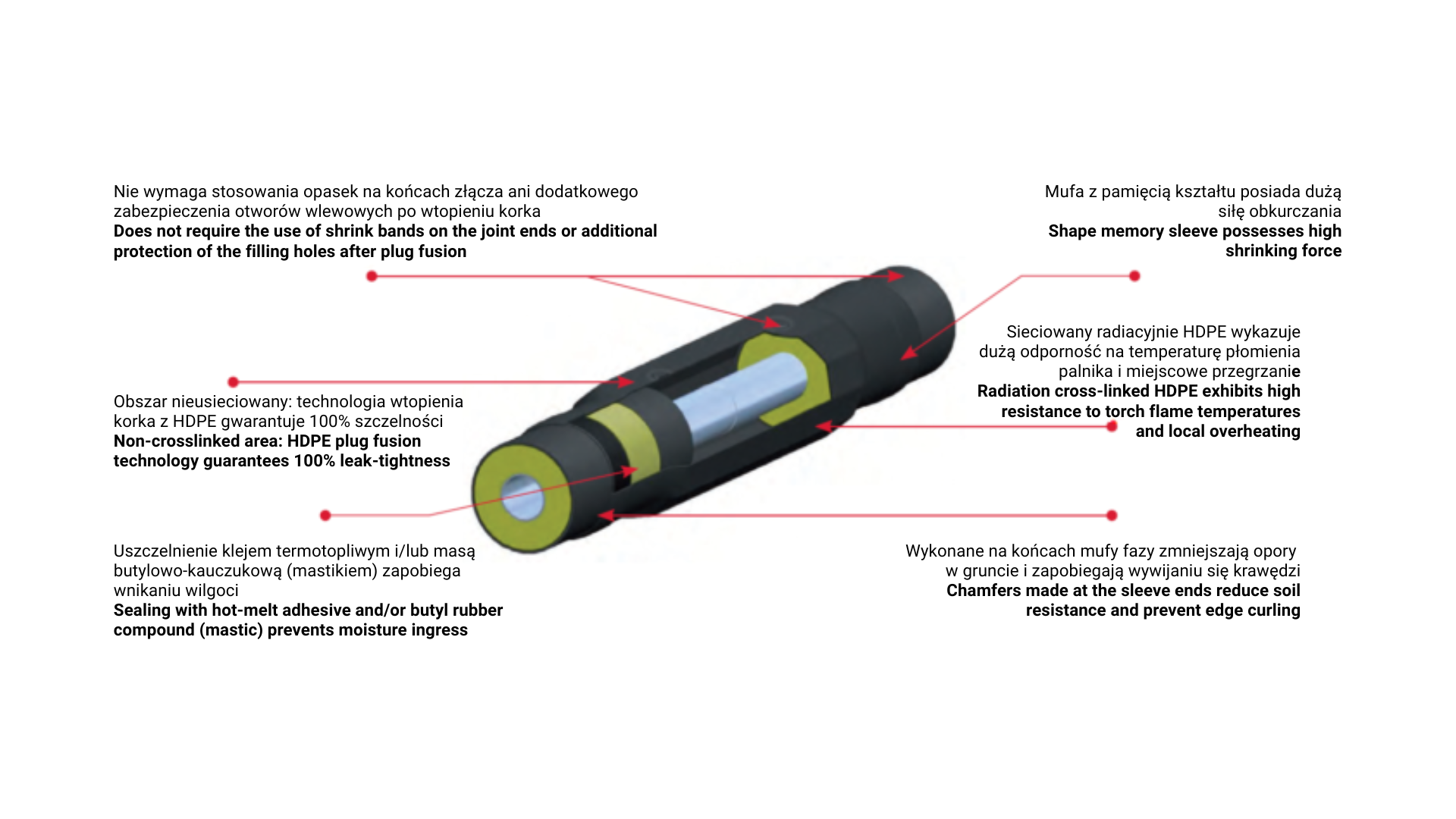
Certified for ground load testing (so-called sand box or box test) for 1000 cycles according to PN-EN 489:2019, with sealing using hot-melt adhesive and butyl-rubber compound.
Equipped with 2 vent plugs and 2 embedment plugs, plus cleaning wipes (complete kit).
Factory-made filling holes are adapted for vent plugs.
Heat-shrink joint made of black high-density polyethylene, radiation-crosslinked.
High mechanical strength of the crosslinked material ensures tear and abrasion resistance.
Proper sealing ensures protection of the joint zone under harsh conditions.
Minimal number of joint components reduces installation time and increases installation efficiency.
Lower joint cost; no heat-shrink clamps are required.
Joints are resistant to corrosive chemicals and UV radiation.
Uniform sealant layer of hot-melt adhesive and/or butyl mastic prevents adhesion of foreign objects and does not detach during sliding of the joint over the carrier pipe.
Sleeve Contents:
Radiation cross-linked heat-shrinkable sleeve with factory-made holes
2 venting plugs
2 welding plugs
2 cleaning wipes
Installation instructions
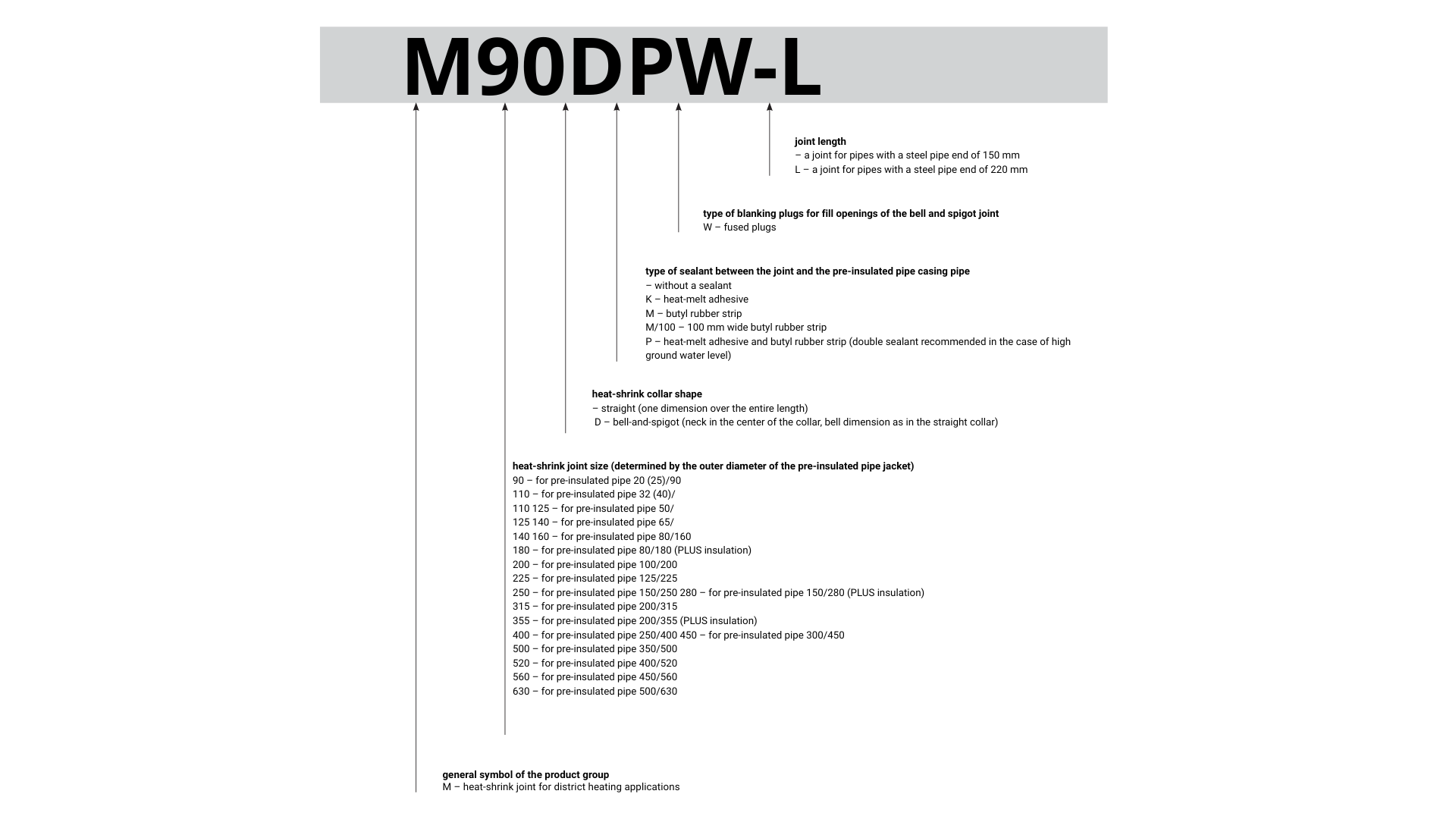
Selection of the heat-shrink bell-ended joint begins by determining the outer diameter of the pre-insulated pipe casing (e.g., 110, 160) and entering it directly after the product group symbol "M".
The key rule is to add the letter "D" after the diameter value, which indicates the selection of a heat-shrink bell-ended joint. Next, match the type of sealing to the ground conditions, choosing e.g., hot melt adhesive (designation "K") or double sealing ("P"), recommended for groundwater presence.
Finally, verify the length of the non-insulated steel pipe end – for the 220 mm dimension, it is necessary to add the symbol "-L" at the end of the code.